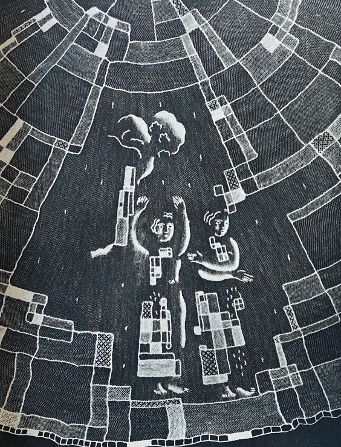
Lecture by Marta Filipová
Marta Filipová
- Register here
- February 5, 2026
- 2026 Speaker Series
Beyond the Central European Village: The Question of Folk Art before 1945
How do we talk about folk art in a context that has been closely linked to modernism in the visual arts? Interwar Central Europe, and Czechoslovakia especially, is often associated with modernist buildings, cubist sculptures and functionalist design. Marta Filipová's talk builds on research that complicates this image and challenges the notion that in the 20th century, folk art was an outlived phenomenon and kitsch. Instead, she approaches folk art as an active participant in modernity that – through its makers, promoters and users – adopted modern narratives and adapted to them. Focusing on specific examples of needlework in Central Europe of the first half of the 20 th century, Dr. Filipová aims to explore and expand the notion of folk art in terms of its content, purpose and geographical location. She argues that folk art practices were intimately intertwined with modern institutions, capitalist societies and economic structures that go beyond the village origins in Czechoslovakia and Central Europe.
Marta Filipová is a Research Fellow at the Department of Art History at the Masaryk University, Brno. She is the head of the Centre for Modern Art and Theory and Principal Investigator of the project Beyond the Village: Folk Cultures as Agents of Modernity, 1918-1945, financed by the Czech Science Foundation. She earned her PhD at the University of Glasgow (2004) and worked as a lecturer and researcher in the United Kingdom until 2019 when she moved to the Czech Republic. Her latest publication is Czechoslovakia at the World’s Fairs. Behind the Façade (CEU Press, 2024), she also published Modernity, History and Politics in Czech Art (Routledge, 2020) and edited the volume Cultures of International Exhibitions 1840-1940. Great Exhibitions in the Margins (Ashgate, 2015).
Image credit: Needle lace (detail), 80cm, designed by Emilie Paličková-Milde, created by The State Lace-Making Course, Nový Kostel, ca 1931.